As seen at AFI Fest 2007:
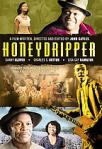
In Honeydripper,
John Sayles points his camera at a setting that is often ignored
by contemporary filmmakers: the American South of the 1950s. The
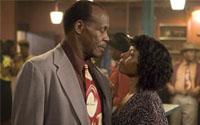
film focuses on Tyrone “Pine Top” Purvis (Danny Glover), the
soulful old-time proprietor of the Honeydripper, a bar and club
in Harmony, Alabama. Despite offering the sweet-sounding vocals
of long-time house singer Bertha Mae (Mable John), the
Honeydripper seems to be doomed to failure now that it has to
compete with a rival club across the street, which has installed
the young-people-magnet that is a jukebox. But Pine Top isn’t
ready to go down without a fight, mainly because he is
determined to get back at his pompous landlord, who would much
rather use the property for other purposes. In order to bring in
some desperately-needed revenue, Pine Top, against his own
personal musical beliefs, books rock-‘n-roll hit-maker Guitar
Sam to play a show at the Honeydripper.
By the time that the day of the
concert rolls around, circumstances change, as expected. The
real Guitar Sam is nowhere to be found. In order to still put on
a show, Pine Top pulls a fast one and hires aspiring young
guitarist Sonny (Gary Clark Jr.), who first came to the
Honeydripper looking for a job after randomly ending up in
Harmony, to pretend as if he is Guitar Sam. This, of course,
also proves a challenge in and of itself. After coming to town,
Sonny is arrested by a racist cop for wandering around aimlessly
without being employed. Tyrone must buy Sonny out of his labor
sentence, in which Sonny picks cotton alongside dozens of other
innocent black men, for the night. After much hoopla, Sonny is
finally able to give the gig a try.
Structurally and thematically, Honeydripper is
Sayles’ most straightforward film to date. Regardless of this,
the movie has a lot to say. Its depiction of black culture in a
setting of extreme racial tension is subtle, factual, and
extremely affecting. The viewer comes to care for the film’s
characters as people,
and this makes the discrimination that they endure seem all the
more disgusting. And, still, the movie is hardly as much about
race relations in America as it is about the joyous, healing
effect of music. Rock-‘n-roll functions as a prominent character
in and of itself in Honeydripper,
providing an equal amount of context for the film as the
cut-and-dry historical elements do. No one song is particularly
striking so much as the work as a whole is: Sayles makes sure to
thoroughly explore the effect and consequence of simple rhythm.
Meanwhile, the humanity found in Honeydripper is
also undeniably moving, with rich, poignant performances coming
from nearly every member of the cast. In the lead role, Glover
is a revelation. As much as I hate the man’s politics and life
outside of Hollywood, it is impossible for me to deny the raw
power of his interpretation of Pine Top. In more ways than one,
the character has a tormented soul during the film’s first two
acts; to observe the manner in which Glover depicts his
transformation of healing as the plot progresses is something of
a miracle. Also exceptionally impressive efforts found in the
ensemble are those of Clark Jr.; Lisa Gay Hamilton as Pine Top’s
wife, Delilah; and Yaya DaCosta as Pine Top’s daughter, China
Doll.
For Sayles, the film is clearly a
deeply personal passion-project (then again, when has one of his
efforts not been?); his care for his characters and the story
that they embody is evident in every frame. Because of this, Honeydripper always
strikes the viewer as an incredibly pleasant work. It softly
builds to create a very enjoyable, accomplished mix of history,
emotion, and art. While I am hesitant to call it a great film
because of the fact that it ultimately lacks consequence, I
certainly recommend it to just about everyone. Rarely do
crowd-pleasers have as much heart or as much intellect as Honeydripper does.
-Danny Baldwin, Bucket Reviews
Review Published on: 11.21.2007
Screened on: 11.4.2007
at the ArcLight Cinemas in Hollywood, CA