
FROM THE BUCKET REVIEWS ARCHIVE
Review: Charlie Wilson's War
Danny Baldwin · December 24, 2007

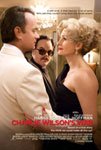
Starring: Tom Hanks, Julia Roberts, Philip Seymour Hoffman, Amy Adams
Directed by: Mike Nichols
Produced by: Tom Hanks, Gary Goetzman
Written by: Aaron Sorkin
Distributor: Universal Pictures
Charlie Wilson’s War represents a rare find in the current Cinema Market: a motion picture about politics that doesn’t try to push an agenda of its own. From Rendition to Lions for Lambs to Redacted, Liberal Hollywood released countless anti-Bush commentaries this year, none of which were successful at the Box Office. The American Public proved, nearly time after time, that it didn’t want to be lectured on political matters by an unknowing elite. Still, the political process became as divisive as ever in the United States, with early Presidential Campaigns that tried to be as separate from one other as possible popping up left and right. American Society still clearly shows an appetite to be educated in historical and political issues, which is why Charlie Wilson’s War is destined to find success. The movie doesn’t tell the viewer how to feel about its real-life characters or issues, it just provides an evenhanded depiction of them that simultaneously entertains and informs. Adults in search of “serious” fare at the Movies need look no further than this film.
That Charlie Wilson’s War is so objective and so unlike its fellow politically-themed Hollywood-productions is rather surprising given the opinionated minds behind it. First and foremost, screenwriter Aaron Sorkin is one of Hollywood’s most prominent, card-carrying liberals. This, of course, has been evidenced in his scripts for the Rob Reiner pictures A Few Good Men and The American President. (Rumor has it that the nature of Sorkin’s work was toned-down for the final cut of Charlie Wilson’s War, but I can’t imagine that it contained the vehement bias of his previous political projects even in its original form.) Also, director Mike Nichols has always leaned happily to the Left and represented this through his career-choices, either overtly (particularly in his Bill Clinton-based Primary Colors) or merely by pushing the envelope (as he did with his controversial Who’s Afraid of Virginia Woolf? and The Graduate).
That Sorkin and Nichols were able to collaborate and create a work more mature than the slanted one that many might have expected from the pair is a refreshing reminder of what Hollywood filmmakers are capable of when they are clear-headed. That being said, Charlie Wilson’s War is no masterpiece. While it may stand as an interesting, thought-provoking work featuring some great performances, the movie isn’t tremendously emotionally-affecting or complex. The material that it tackles is a bit too low-key to lead to a work of great significance. Tom Hanks plays title-figure Charlie Wilson, a Texas congressman who, through a variety of channels, became one of the few American Representatives who understood the dire effects of the Soviet Union’s invasion of Afghanistan late in the Cold War. Wilson made it his duty to see that legislation providing the Afghans with adequate weaponry to fight the Soviets was passed. In Charlie’s decisions, the viewer instantly draws parallels to those currently being made by leaders in regards to the Middle East, which is obviously as much an issue now as it was then.
As grand (or ill-fated, depending on how one looks at them) as Charlie Wilson’s accomplishments in Congress may have been, Nichols’ film is as much about Wilson himself as it is about international politics. This narrative-choice is simultaneously the movie’s biggest downfall and most interesting achievement. Nichols and Sorkin delve greatly into Charlie’s personal life, making sure to depict him as something of a political playboy. Charlie had his office run almost entirely by attractive woman (his second-in-command is here played by the gorgeous Amy Adams), he drank whiskey excessively, and he partied (and was accused of doing cocaine) with strippers and nudie-magazine models. Often, this focus dilutes the considerable historical punch that Charlie Wilson’s War packs. At the same time, it does allow Charlie to become a well-developed character rather than a trivial one, and gives Hanks quite a bit of creative freedom to explore the man’s boisterous personality. The fact that such a crude and carefree figure could devote so much of his attention to a foreign political-issue is rather fascinating.
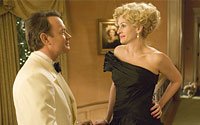
Speaking of Hanks: he’s excellent here. The actor’s laid-back presence as a leading-man does justice to Wilson’s charismatic (if often politically-questioned) exterior. And his tremendous work only headlines the also-fantastic efforts of the rest of the cast! Julia Roberts turns in her best acting work in some time as Texas businesswoman Joanne Herring, who originally pushes Wilson to become the vocal advocate of the militarization of Afghanistan that he does. As a CIA operative who helps Wilson in the acquisition of weapons-contracts with foreign powers, Philip Seymour Hoffman is extraordinary. He perfectly balances comic-relief and character-conviction to craft a show-stealing performance. Additionally, the aforementioned Amy Adams is quite charming in her bit-part.
For a piece of filmmaking that is both thoughtful and entertaining, moviegoers can’t do much better this Christmas Holiday than Charlie Wilson’s War. Even if it isn’t significant or ground-breaking enough to qualify as a truly great piece of filmmaking, the movie is well worth seeing. Let’s hope that it finds an audience and that this allows the rest of Hollywood to take a hint that politically-themed projects don’t always have to be radical to prove a point.
-Danny Baldwin, Bucket Reviews
Review Published on: 12.24.2007
Screened on: 12.24.2007 at the Edwards San Marcos 18 in San Marcos, CA.
Charlie Wilson's War is rated R and runs 97 minutes.