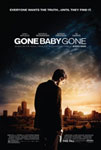
Following in the footsteps of many of his cohorts in
Hollywood, actor Ben Affleck has decided to try his luck at
directing. The good news: Affleck’s debut feature, Gone
Baby Gone, is a solid piece of filmmaking for a first-timer.
The bad news: the movie’s major downfall is that it feels like
the work of a freshman, despite its admirable production values.
Among Affleck’s greatest
accomplishments in Gone
Baby Gone is his
loving creation of a living, breathing setting of working-class
Boston. He allows the city (his hometown) to vividly form a
character of its own in his movie, imbuing in the material a
much-needed sense of context. The opening shots of the people
and places featured in the film are especially memorable,
perfectly setting the tone for what’s to come.
Ben’s brother Casey plays protagonist
Patrick Kenzie, a private investigator in the aforementioned
Bostonian setting. Clients call on Patrick and his girlfriend,
Angie (Michelle Monaghan), to look into neighborhood crimes
because the two know how to find a lot of people in the area
that don’t usually associate with the police. Gone
Baby Gone’s plot takes off when the pair is confronted by
Lionel and Beatrice McCready (Titus Welliver and Amy Madigan),
whose four-year-old niece Amanda has been missing for three
days. Amanda’s mother Helene (Amy Ryan) is a depressed
drug-addict who is more or less useless to the cause of finding
her daughter, and her reckless behavior very well may have led
to Amanda’s kidnapping.
As Patrick and Angie track Amanda’s
case, they discover over time that it isn’t as simple as it once
seemed to them. Affleck stays with the quick-moving plot
competently for the majority of the film, but his lack of
experience behind the camera leads to the collapse of Gone
Baby Gone’s third act. Affleck lacks the directorial
confidence needed to make this portion of the film seem natural
and, as a result, his artistic hand becomes apparent to the
audience. The film bargains much of its success on the power of
the complex moral dilemmas offered by its climax and resolution,
which ends up being muted at best. Because he was unsure of his
abilities as a director in assembling the film, Affleck
overcompensated by exaggerating said dilemmas, which should’ve
come off as subtle and nuanced. Instead, they are force-fed to
the viewer in what seems like an overwrought thematic lecture.
Affleck forgets that the touch of even the most experimental of
filmmakers should be invisible to their audience. Watching the
finale of Gone
Baby Gone, I wouldn’t have been surprised to have seen
puppet-strings moving the arms of the characters and Affleck
controlling them from the upper edge of the frame.
One thing that Affleck can be credited
for sustaining for the length of Gone
Baby Gone, however, is his brother Casey’s lead performance.
With Ben’s direction, Casey maintains a stunning level of depth
in a character that could’ve easily become trivialized by a
less-skilled actor. He develops a great amount of authenticity
to both the anguish and the redemption that Patrick feels in the
film’s final moments, perhaps slightly redeeming the
miscalculated way in which his brother handles this portion of
the film. Between his outstanding work in Gone
Baby Gone and in The
Assassination of Jesse James by the Coward Robert Ford,
Casey should find due recognition come Oscar time.
Despite the considerable flaws found
in his direction, Affleck still shows strong promise behind the
camera. Given he isn’t exactly great at acting, there is no
reason that Affleck shouldn’t work on improving his directing
abilities instead. His work onGone Baby Gone, if nothing
else, provides audiences a reason to eagerly await his next
feature.
-Danny Baldwin, Bucket Reviews
Review Published on: 10.28.2007
Screened on: 10.19.2007
at the Edwards San Marcos 18 in San Marcos, CA.