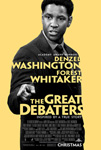
The Great
Debaters tells
the (of course) true story of the 1935 Wiley College Debate
Team, which consisted of four black students who dared to thrive
academically in a time of extreme racial tension in America. The
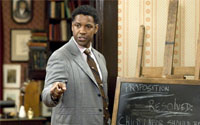
team was headed by Mel Tolson (Denzel Washington, who also
directs the film), a hardworking professor at Wiley suspected of
being an active communist by many of the residents of the
school’s surrounding town of Marshall, Texas. (Tolson was
actually a very vocal advocate of sharecroppers’ unions and a
poet in the Harlem Renaissance, but he never let his personal
life or political views enter the classroom.) Tolson cultivated
the team with modest intentions, only seeking victories over
other black colleges, Howard the most respected among them. But
when his team began to receive national recognition, its
existence became a hot-button issue for many racist Americans.
Fighting onward, Tolson and his students won nearly every match
they took part in, eventually earning the chance to beat the
national-champion, USC (replaced by Harvard-Crimson in the film,
presumably to make the honor seem even more monumental).
The movie tells a highly conventional
Underdog Story, but critic Roger Ebert reminds us that this
isn’t necessarily a bad thing. In his review, Ebert writes:
“…some critics have complained that [The Great Debaters]
follows the formula of all sports movies by leading up, through
great adversity, to a victory in the end. So it does. How many
sports movies, or movies about underdogs competing in any way,
have you seen that end in defeat? It is human nature to seek
inspiration in victory, and this is a film that is affirming and
inspiring and recreates the stories of a remarkable team and its
coach.” For the most part, I agree with him. After all, what
would The Great
Debaters have
said about racial progress if it had chosen to tell a
less-optimistic story about the same theme? Unfortunately,
however, there is a separate problem with the movie’s embrace of
convention that Ebert overlooks: one that concerns its style,
not its content. Director Washington makes the story feel more
tired than it really is by presenting it in the same fashion as
those like it, with plenty of syrupy slow-motion shots and
sentimental background-music to boot. Had he merely assembled The
Great Debaters in
a more atypical way and kept the central message the same, the
movie could’ve been a more provocative and more powerful film on
the whole.
Then again, perhaps I’m taking the
largely-successful picture for granted by criticizing it at all.
In truth, The
Great Debatersrepresents a rarity in that it succeeds in
embracing such a derivative formula. There are, indeed, many
elements of great, often very fresh work here. Namely, Forest
Whitaker’s interpretation of a distanced intellectual who is
both one of Tolson’s colleagues at Wiley and the father of the
debate team’s researcher is phenomenal. The performance stands
apart from all of the conventions of The
Great Debaters, offering an entirely different take on a
father-figure than this type of film usually does but satisfying
just the same. In addition, Washington’s bold, heroic depiction
of Tolson is quite welcome. Despite living in a desperate time
in America when it would’ve been all too tempting to affect
students by preaching his own politics to them, Tolson resists
the urge. Reflecting upon this in today’s educational
environment, in which public schoolteachers almost uniformly
brainwash kids with far-left doctrine, makes the notion
especially admirable.
Cliché as its story and style may
seem, The Great
Debaters is
nonetheless a triumphant viewing experience. I have merely
touched on what makes the picture the special one that it is in
this review, but to dwell on all of its specific joys would only
spoil them. In short, I wholeheartedly recommend that everyone
support The Great
Debaters for its
ripe historical value, nuanced performances, and welcome ability
to uplift the viewer’s spirits. What an appreciable effort this
is.
-Danny Baldwin, Bucket Reviews
Review Published on: 12.29.2007
Screened on: 12.26.2007
at the Regal Escondido 16 in Escondido, CA.