On
the surface, Interview is another one of those
art-pictures that raises that infamous critical question:
must a viewer sympathize with at least one character in a movie
to be able to enjoy it? Typically, my answer to this question
would be a definite “yes,” but this film represents an exception
to the norm. In fact, the two main characters in Interview
are so far removed from the realities of the Manhattan
surrounding them—their actions and thoughts are so internalized
that find themselves merely floating in a whirlwind of
condemnable moral dilemmas—that it would be fruitless of the
viewer to expect to find any redeeming or empathetic qualities
in either of them. Interview doesn’t work because it
allows the viewer to understand these characters, but rather
because it indulges said viewer’s fascination for the plane on
which said characters exist.
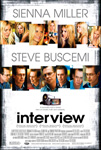
The leading duo
is played by Steve Buscemi and Sienna Miller. He’s
self-promoting and thick-headed journalist Pierre Peders and
she’s Katya, the air-headed “actress” who he has been assigned
to interview over dinner. The interview is uncomfortable for the
both of them from the moment that they begin to talk: Pierre
feels that the task of interviewing a popular celebrity is
beneath an important political muckraker such as himself and
Katya is offended that he would display such a lack of interest
in his subject. One thing leads to another, and the two end up
in Katya’s New York City loft, engaging in a slimy-but-addictive
war of words while swigging down alcohol by the quart. As the
night progresses and each becomes further enraptured in the
morbid and uncanny chokehold they have over the other,
revelations begin to surface about both Pierre and Katya through
the method of their own confession.
Interview
may contain one too many twists regarding Pierre and Katya’s
pasts, but is nonetheless an unflinching portrait of two
individuals who have found nothing but filth through interaction
in their respective social circles. It’s engrossing to watch
each character attempt to feel better about their self by
taunting the other. Buscemi and Miller are both revelatory in
these roles, getting their hands dirty as they embody the two
corrupted individuals. What’s more: despite its generally yucky
antics, Interview never ceases to function as an accurate
narrative-manipulation of identifiable personalities. In other
words, even if Pierre and Katya may not be entirely realistic
characters in and of themselves, they inhabit character-traits
representative of their respective “type” of person, thereby
evoking a stimulating study of each’s function in society.
I am informed
that Interview is a remake of a 2003 film by Theo van
Gogh, the Dutch filmmaker who was recently slain by a Muslim
extremist. This fact seems somewhat strange, given how
distinctly American this picture feels. Miller’s Katya comes off
as a more-intellectual hybrid of Lindsay Lohan and Paris Hilton,
and Buscemi’s Pierre is a spot-on representation of just about
every other mainstream American journalist currently working.
Even when Interview tosses somewhat implausible
character-epiphanies into its plot, it always feels to be
naturally progressing due to the naively sophisticated nature of
its pop-culture-driven Americana setting.
Interview
may not be an enjoyable motion picture by default, but I found
reward in the process of being engrossed in the socially-removed
interaction between its focal characters. A viewer looking for
immediate satisfaction in a film’s content should not come near
this movie; its most-riveting qualities are only digestible
after the work is considered as a thematic-whole. In many
senses, Interview is what Mike Nichols’ 2004 feature,
Closer, would’ve been had Nichols not tried to suggest his
characters were normal, everyday people. Pierre and Katya are
nasty and perhaps hollow individuals, but they provoke a strong
audience reaction as Interview progresses and ends. The
film is—all at once—pungent, malaise, and relentless. Those who
see it may not like what they witness, but they won’t soon
forget it, either.
-Danny Baldwin,
Bucket Reviews
Review Published
on: 8.5.2007
Screened on:
8.4.2007 at the Landmark Hillcrest
in San Diego, CA.
Interview is rated R and runs 84
minutes.
Back to Home