“I’ll paraphrase
Thoreau here: Rather than love, than money, than faith, than
fame, than fairness – give me truth.”
So explains
protagonist Christopher McCandless (Emile Hirsch) early on in
Sean Penn’s illuminating Into the Wild, legitimizing to
another character the venture that he dubs as his “Great Alaskan
Journey.” McCandless was a real young man who really did, after
graduating from Emory University, travel to the wilderness near
Fairbanks, Alaska to live off the land there for many months.
Whether he did it in the romantic way that Penn shows the viewer
is debatable—I hear that John Krakauer’s source-novel reads
somewhat like a fictional take on reality—but this is
insignificant to the film’s success on the whole. Into the
Wild is more of a freeing experience than it is a
biographical one, taking the very same cues from Thoreau and
Jack Kerouac that once prompted McCandless to embark on his
expedition. The movie is a resoundingly natural, ethereal
portrait of the pureness and adventurousness of the follies of
youth, admiring them just as much as it understands their grave
consequences within the context of McCandless’ life.
The film is a
sprawling exercise in the post-modern style, and appreciably so.
Penn takes on a rather ridiculous amount of material in a manner
that is as inventive as it is flowing. The viewer first meets
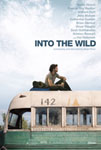
Christopher when he has already made it to Alaska, staking out
his territory and discovering an abandoned public bus to make
camp in. Hirsch, much more serious here than Tom Hanks was in
the similarly-themed Cast Away, does not speak a word as
this unfolds. Through his nuanced physical-acting and the
onscreen presence of the words that his character has written in
a letter to friend and past employer Wayne (Vince Vaughn, who is
introduced later in the film), a tremendous amount about
Christopher’s character is reveled in the opening sequence. This
structure remains constant throughout the rest of the film;
Christopher’s life in The Wild is revealed in between flashbacks
that show how he came to reach said destination.
As the viewer
learns more about what Christopher voluntarily endured to get to
Alaska due to his own hopeless sense of romanticism—and how much
it changed him as a person, for better or for worse—the more
they are affected by the building sense of climax that Penn
achieves. The material strikes an emotional chord from the
get-go, as it becomes clear that Christopher and his sister
(Jena Malone, who narrates a solid portion of the film) were not
properly cared for by their sourly prim middle-class parents
(William Hurt and Marcia Gay Harden, both of whom are fantastic
here). One of the most telling moments involving Christopher’s
family comes as they share a conversation at lunch after his
graduation. Satisfied by their new ability to tout that their
son has finished his undergraduate work at a well-regarded
university and will likely soon be moving onto Harvard Law,
Christopher’s parents offer to buy him a brand new car. At this
thought, Christopher develops a bit of a twinkle in his eye, not
because (as one might expect) the idea brings him happiness, but
because it provides him a public way of showing his denouncement
of material possessions. “Why would I want a new car?” he
finally retorts, “The Datsun runs great.”
And soon
enough, as foreshadowed by the material set in Alaska,
Christopher soon ventures Into the Wild, carrying the alias
“Alexander Supertramp” at his side. Whether “the Wild” comes in
the form of his ultimate destination or that of his journey to
the destination is up to the individual viewer to decide. While
waiting (primarily in California) until Spring to escape to the
Alaskan Wilderness, Christopher meets a plethora of interesting
people: namely Rainy (Brian Dierker) and Jan (Katherine Keener),
two book-hording, RV-toting hippies; previously-mentioned Wayne
(Vaughn), the owner of a wheat-farm who dabbles in an illegal
business on the side; Tracy (Kristen Stewart), a teenage girl
who develops a deep-seeded crush on Christopher’s glamorous view
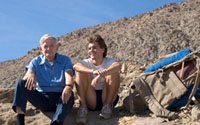
of rugged individualism; and Ron (Hal Holbrook), an old
military-veteran living in Salton City who works to develop
himself as a father-figure for Christopher. Christopher is left
uncannily touched by all of these individuals, so much so that
the viewer’s emotional investment in his well-being (and notice
of his foreshadowed downfall) creates the home that their
presence in “normal life” will affect him enough to make him
want to abandon his dangerous expedition. But that just wouldn’t
be Christopher—the stubborn kid who would stop at nothing to
feed his obsessions—would it? “You place too much value in human
relationships,” Christopher tells Ron late in the film. In my
view, this comment comes back to bite him when the film
concludes.
There is not a
single performance that isn’t dead-on in Into the Wild,
not a line of dialogue that isn’t in its place. This is that
rare motion picture that feels as though it’s unfolding
as one watches it, rather than merely taking up time.
Every single one of its 148 minutes is well-earned. Is the film
a masterpiece? After seeing it twice, I am close to being
inclined to think so. While I have my gripes about a few of the
more experimental techniques used by Penn—his choice to allow
Hirsch to look directly at the audience on two separate
occasions creates an iffy result at best—they seem
inconsequential in retrospect. When I consider the life that
Into the Wild allowed me to feel as I watched it, I come to
realize that the film’s technical imperfections only work to
further the flawed humanism that it wishes to convey in
Christopher’s character. This is a wonderful, wonderful motion
picture.
-Danny Baldwin,
Bucket Reviews
Review Published
on: 10.16.2007
Screened on:
10.6.2007 (first viewing) and 10.10.2007 (second viewing) at the
Landmark Hillcrest Cinemas in San Diego, CA.
Into the Wild is rated R and runs 140
minutes.
Back to Home