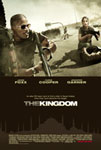
Peter Berg’s The Kingdom is
not only a masterpiece for what it accomplishes on a narrative
level, but also for what it does on an ideological front. The
film, which deals with issues concerning current U.S. foreign
policy in the Middle East, vaguely recounts World War II
propaganda pictures in that it fearlessly functions as both an
insightful political commentary and an engaging action flick.
But unlike those trivial—if admirable and
troop-rallying—pictures, The Kingdom is complex and
analytical of the United States’ role in the War on Terror. It
is an unflinching, terrifying look at the consequences of both
military action and inaction.
After a short
opening segment detailing the history of oil and terror in the
Middle East, The Kingdom shifts its attention to one of
the most daring sequences in the history of cinema. Director
Berg steps back to observe a fictional (but entirely possible)
terrorist attack on an American Housing Compound in Saudi Arabia
lodging oil company workers and their families. Shrapnel flies,
buildings explode, and blood hits the streets – the approach is
sensationalist, but why shouldn’t it be? The images depicted are
disturbingly real and are therefore, by their nature,
sensational. Berg forces the viewer to realize that this vision
could easily become a reality, jarringly setting a pressing tone
for the remainder of the picture. Unlike the cartoonishly
controversial nuclear bombing of Los Angeles constructed on TV’s
“24” earlier this year, the sequence is visceral and raw.
The viewer is
then transported to the United States, where they observe the
frenetic turmoil the event has created in the American
Intelligence Community. Because Saudi Arabia is technically an
ally of the United States, the Administration sees inherent
problems in sending soldiers to retaliate against the Enemy that
has carried out the attack. With apprehensive permission granted
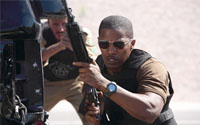
by the Saudi Prince, the government sends four F.B.I.
agents—Ronald Fluery (Jamie Foxx), Janet Mayes (Jennifer
Garner), Adam Leavitt (Jason Bateman), and Grant Sykes (Chris
Cooper)—to investigate the crime. Led by Saudi Col. Al-Ghazi (Ashraf
Barhom), the group discovers many harsh truths about the
attackers, much thanks to the full security clearance they are
given in the country after Fluery demands such in nasty
confrontation with the Prince.
As it
progresses, The Kingdom mixes political philosophy with
action genre-conventions to an increasingly great degree.
Thankfully, the filmmakers and cast pull this combination off
expertly and its presence enhances the picture’s power. American
Viewers are united by their belief in the F.B.I. team’s
excellence and, as a result, come to clearly understand the
foreign policy-related implications of the situation at hand.
(Aiding this are the wonderfully charismatic four leads, who
believably play their characters despite not fitting the
accepted stereotypes of the roles.) While The Kingdom
isn’t heavily partisan, its ability to show the current
injustices being committed on a global scale forms an undeniable
statement that advocates the use of necessary American military
force in the Middle East as well as the strengthening of the
international intelligence community. The film eloquently
vocalizes a singular truth: both Islamic Extremists and members
of the Western World are ready to fight each other to the death,
and the sole victor will be the one who is willing to fight
harder.
Some may
complain that The Kingdom is “too complicated” or “too
unclear.” Many of said complaints will stem from Berg’s
decision, in conjunction with the studio, to cut the movie’s
running length from 150 minutes down to 110 minutes. Admittedly,
a lot of story-related details were lost in this process, but I
am certainly a fan of the decision. Viewers might be confused as
to what the team of F.B.I. agents is talking about at certain
times, but they should be. Much of The Kingdom’s power
rests in the fact that it acknowledges that the United States’
situation in the Middle East is one of stunning complexity that
proves far too nuanced for the average citizen to understand. In
addition, had the forty minutes left on the editing-room floor
been included in the final cut, they probably would’ve provided
the picture a bloated feel, thereby diluting the kick-ass force
of the action scenes.
A mesmerizing
wake-up call to the realities of global terror and all of its
political implications, The Kingdom is undoubtedly one of
2007’s finest offerings. For director Berg, it’s a masterpiece
of an accomplishment, imbuing the same deep sense of humanity
that he was able to capture in previous films (Friday Night
Lights, in particular) with a much-needed subtext. I will
not soon forget this motion picture.
-Danny Baldwin,
Bucket Reviews
Review Published
on: 9.18.2007
Screened on:
9.15.2007 at the Edwards San Marcos 18 in San Marcos, CA.
The Kingdom is rated R and runs 110
minutes.
Back to Home