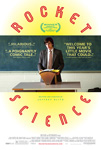
Recalling the
deviously sly Max Fischer from 1999’s Rushmore, the
protagonist of Jeffrey Blitz’ Rocket Science isn’t
instantly likable. In fact, viewers may not ever find the
stuttering Hal Heffner (played by Reece Daniel Thompson)
sympathetic by the time the film’s final frame rolls through the
projector. Hal isn’t the type of character one might want to get
up and hug at any point during the duration, but few high school
students his age are. At times, Hal even seems ornately
annoying, but this comes with the territory of “finding his
voice,” as the film’s narrator elegantly puts it in the opening
sequence.
Hal speaks with
a stutter and, in addition to the psychological harms of his
dysfunctional family, this lends to him being a social outsider.
Only his older brother Earl (Vincent Piazza), who constantly
beats up on Hal out of confusion, is ever really there to talk
to him. That is, until Ginny Ryerson (Anna Kendrick), the high
school’s star debater, strangely recruits Hal to be her
tournament-partner one day on the school-bus. Hal becomes
obsessed with the image of Ginny, despite the fact that his
stuttering lends itself to downright horrible debating abilities
(almost certainly the kind that would lose the pair
competitions). Hal is so enamored by Ginny, in fact, that after
she finds him cowering from a practice-round in the school
janitor’s closet, he tries to make out with her. This does not
go well, to say the least. Hal later asks a Catholic schoolgirl
if what he did with Ginny—“groping with breasts,” as he puts
it—counts as “second base.” “Maybe in public school,” she
retorts. Hal seeks revenge against an indifferent Ginny, who has
since has switched schools and taken up a relationship with her
new, ethnic debate partner.
Director
Jeffrey Blitz made the 2002 documentary Spellbound, which
tackled the world of competitive spelling bees. Where that film
was unfocused and rather dry, this one is riveting and layered.
Blitz has found an anchor for his talents in the form of
narrative drama. His screenplay is sharp and bitingly satirical,
and his efficient direction holds the movie to a brisk 98-minute
running-length. Blitz gets everything about Hal’s character
right: while Hal may not be entirely sympathetic, he’s always
empathetic, and this allows for a well-developed personality. If
Rocked Science finds the large audience that Rushmore
did, I suspect that Hal Hefner will join Max Fischer as one
of the more-admired contemporary anti-heroes in cinema, much due
to Blitz’ treatment of the character.
Rocket
Science’s ending, like much of the rest of the film,
knowingly defies convention. This reaffirms the movie’s status
as one of the more real—if entirely offbeat and quirky—motion
pictures made about the high school experience. Blitz proves
himself to be a highly promising director here, and his writing
is also top-notch. Rocket Science is well worth seeing.
-Danny Baldwin,
Bucket Reviews
Review Published
on: 8.20.2007
Screened on:
8.18.2007 at the Landmark Hillcrest in San Diego, CA.
Rocket Science is rated R and runs 98
minutes.
Back to Home