
FROM THE BUCKET REVIEWS ARCHIVE
Review: Stardust
Danny Baldwin · August 12, 2007

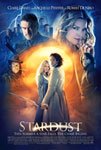
Starring: Claire Danes, Robert De Niro, Michelle Pfeiffer, Sienna Miller
Directed by: Matthew Vaughn
Produced by: Matthew Vaugn, Lorenzo di Bonaventura, Michael Dreyer, Neil Gaiman
Written by: Matthew Vaughn, Jane Goldman
Distributor: Paramount Pictures

Taking a cue from the classical whimsy of The Princess Bride, Matthew Vaughn’s Stardust is a rollicking adventure of a good time. This is a post-modern rendition of old-fashioned fantasy of the purest caliber, equally entrancing in terms of its mythical tone and its creative imagery. By all means, the picture represents a welcome return for Hollywood to a more illusive form of storytelling: its wondrous computer-generated visuals are treated as figments of an imagined body of work rather than show-stopping cinematic tricks. For this reason more than any other, Stardust succeeds as a motion picture. It immerses its audience into an entirely believable, mystical world.
The detailed story on display here is difficult to explain in a few paragraphs, but I’ll try my best to do so. In Stardust, Tristan (Charlie Cox), a young man who lives in an English town that borders a magical other-world, is dying to express his hopeless love for the pompous and superficial Victoria (Sienna Miller). Unfortunately, Victoria is about to marry Humphrey (Henry Cavil), a rich and charming aristocrat whom with she is more socially compatible. One night, Tristan and Victoria see a star falling in the sky, a sight which she deeply admires and hence provokes a deal: if Tristan can retrieve this star for Victoria in one week, she will marry him instead of Humphrey.
This all sounds good and jolly, but the tricky part of the matter is that the star fell in the world next to Wall, the border-town in which the two reside. It is not easy for one to enter the foreign land, but Tristan soon learns that his father is one of the few who have done so, and that his long-lost mother is actually being held slave to a witch there. Using a sort-of mystical teleportation candle his mother sent him after he was born—his father had been hiding this for years—Tristan is able to enter the kingdom of Stormhold, as it is called. He finds himself right in front of the fallen star, which takes the form of a woman in the mythical land; her name is Yvaine (Claire Daines). And as if that wasn’t easy enough: Tristan isn’t the only one seeking Yvaine for his own personal reasons. In order to become the King of Stronghold, the Princes in-waiting of the Kingdom must claim her for themselves. Also in competition: wicked witch Lamia (Michelle Pfieffer), who wants Yvaine’s heart, which will provide she and her sisters with eternal youth.
Of course, in the nature of all great fantasy, a love story brews at the heart of Stardust. As Tristan bends over backwards to hold onto Yvaine, he realizes what a wonderful woman she is, especially compared to his previous perception of the ideal female (and reason for finding Yvaine), Victoria. As Yvaine, Claire Daines is stunning and surprisingly sexy. Her chemistry with fellow lead Charlie Cox is abundant in every frame the two performers share together, and this complements the far-out action to form a cohesive whole picture.
As I conclude this review, I realize that most of what I have just said is just mindless plot-description. The truth of the matter is that it would be hard to write about Stardust in any other way. Like all good fantasies, the film’s detailed wildness is what makes it the rewarding motion picture that it is. It’s hard to really criticize this type of movie because it is so unique unto itself. On the surface, my sole complaint with this one is that, at two hours and eight minutes, it runs about a half an hour too long. Otherwise, I really cannot say much about my opinion of Stardust other than that the film worked for me. It proves itself to be well worth the price of admission.
-Danny Baldwin, Bucket Reviews
Review Published on: 8.12.2007
Stardust is rated PG-13 and runs 128 minutes.