I have never
tried to make a horror film of my own, but after watching dozens
(if not hundreds) of them, I feel qualified to speculate on what
the hardest thing about the process is. It seems to me, based on
all of the horror pictures that I have sat through over the
years, that the most crucial and yet most seldom accomplishment
made by filmmakers in the genre is the act of properly balancing
the moment and the inevitable. Horror movies, to a greater
degree than any other type, must keep the viewer captivated by
the suspense created by their villains while at the same time
leaving the characters’ ultimate fate in said viewer’s mind.
This balance allows the writer and director to evoke a sense of
impending doom (or, in a select few cases, optimism) that aids
their film’s sense of dramatic tension while still keeping the
audience chained to its seat in a state of, well, horror.
Bryan Bertino’s
The Strangers not only accomplishes the aforementioned
balancing-act, but takes it to a higher level. Not only does
Bertino imbue a doomy, gloomy tone in his picture: he also
confidently lets his viewer know the soon-to-be-terrorized
protagonists’ likely fate in the opening scene. The film begins
with a stark and monotone narration-sequence, not unlike that
employed by Marcus Nispel’s 2003 remake of The Texas Chainsaw
Massacre. The audience is informed that—as far as I can
remember—couple James Hoyt (Scott Speedman) and Kristen McKay (Liv
Tyler) were brutally tortured in a manner that subsequent
investigations were not able to make sense of. I say “as far as
I can remember” because what followed—the real account of what
happened to James and Kristen—jarred me and kept me transfixed
to such an extent that I felt so caught up in the action that I
never allowed myself a spare moment to stop and consider the
opening. From my shaken perspective, I was existing alongside
these two characters as they struggled to survive against
psychopathic, masked killers terrorizing their vacation-home.
And, even after watching the film’s ending and mulling-over
Bertino’s opening-hint, I can’t definitely say if one of them
lived or died. Bertino puts everything on the table and hides it
at the same time and, in the process, forges a reason to care
for James and Kristen through the surreal quality about the
material developed therein, whatever the pair’s ultimate fate.
Then again,
others will undeniably read the movie differently than me and
find it completely straightforward. In this very fact lies the
true, rare wonderfulness of the movie: it’s not simply a horror
picture, but a motion picture. The Strangers,
while distinctly sticking to the traditions and structure of the
films of the horror genre, is a “movie” before it is a “horror
movie.” It offers an experience that is as emotionally-rattling
and downright fascinating as any other one will ever have at a
cinema.
In the
aforementioned realization of the picture’s rare ability to
transcend mere categorization for all-intensive purposes, I have
perhaps discovered that its magic doesn’t so much lie in its
perfect contrast of climax and conclusion, but its mastery of
another juxtaposition: that between expectation and reality.
Indeed, The Strangers may look and feel like a standard
horror picture, but it diverges from the core principles of the
genre more often than it adheres to them. When the details of
the story don’t exactly move in the way we expect them to, the
exercise proves horrifying in and of itself, dramatic tension
aside. Because Bertino tells us where the picture is headed and
we know how other films of the sort have reached similar
destinations, The Strangers attains a remarkable level of
unpredictability when it strays from the norm. In deliberate
contrast to what one might expect: the protagonists are afforded
an entire first-act of character development, allowing them to
evoke genuine sympathy in the viewer; there are no illogical or
exaggerated plot-conveniences afforded to the protagonists or
the antagonists, allowing the movie to take on a surprisingly
realistic tone; and the central action, for the most part,
occurs within the claustrophobic 100-foot-radius of James and
Kristen’s vacation-home. Startlingly coupled with genre-standard
high shot-exposure levels, handheld shots showcasing the
protagonists’ vulnerable upper profiles, and climactic
employment of ironically upbeat musical choices, the traits are
effective in dumbfounding the viewer into their complete
engrossment in the material.
To aid matters,
the villains and their victims couldn’t be better defined.
Wreaking havoc on James and Kristen by attempting to frighten
and murder them within the confines of their country
vacation-home, the three masked antagonists are terrifying. The
viewer is only able to see their lower-bodies until the very end
of the film, a greatly effective strategy on Bertino’s part.
What’s most striking about the evil trio for The Strangers’
first eighty minutes is the fact that they come across as
distinctly modern villains. Fit in build and provided
only a single line of clearly-spoken dialogue between the three
of them, they are not the standard incestuous Southern hick
villains that one is used to seeing in slasher-flicks. They are
real people, and the fact that they are so insane as to
inflict such irrational harm on James and Kristen within the
confines of such perceived normalcy makes them all the more
terrifying.
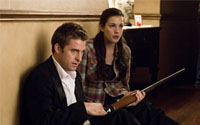
Providing
ample contrast to the malicious antagonists, protagonists James
and Kristen couldn’t be more likable. The viewer meets the
central two as they are presumably about to break their
relationship off, having come from a gathering at which James
proposed to Kristen to a painstaking rejection. It becomes all
the more unbearable when they enter the vacation-home, which
James had filled with rose-peddles expecting it to be the venue
of a happier time. “I didn’t know whether you were supposed to
put them in before or after you filled it up,” he poetically
confesses to her in quiet desperation as she draws a bath in a
peddle-filled basin. Both characters feel tremendously authentic
and empathetic, especially during a heated moment in which they
caress each other before break-up sex that is interrupted by the
villains’ thunderous first knock on their dwelling’s door. Of
the two performers, Liv Tyler is especially heartbreaking, both
before the central action kicks in and during it.
The
Strangers has been compared to last year’s also-excellent
horror-picture Vacancy by a sizable amount of critics.
While the two films share the common premise of a
romantically-challenged couple coming together when thrust into
an extraordinarily violent situation, I can’t help but feel that
The Strangers is in a higher league. While Vacancy
was innovative in its own way, it had the advantages of a nifty
set and further-explored antagonists, indulging in the
protagonists’ attempts to escape from a murder-filled motel and
delving into their opponents’ motivations for killing. This
movie, on the other hand, is stripped down to the bare
essentials of filmmaking, creating a situation that comes across
as frighteningly possible in the ways that it manipulates
limited space and convincing characterizations. In a cinematic
day in which disastrously overcomplicated storytelling fueling
plainly-obvious plots is the norm—especially in the horror
genre—it’s particularly nice to see a picture that understands
its ability to utilize the conveniences and innovations of
conventional narrative-building to craft an
emotionally-affecting abstraction of reality. Unexpected as it
may be, The Strangers represents cinema verite at
its finest.
-Danny Baldwin,
Bucket Reviews
Review Published
on: 6.1.2008
Screened on:
5.31.2008 at the Edwards San Marcos 18 in San Marcos, CA.
The Strangers is rated R and runs 85
minutes.
Back to Home