 |
Externally,
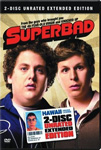
Superbad—a film about the teenage misadventures of a pair of
socially-challenged best friends trying to get laid and score
girlfriends before they graduate from high school—plays very
much in the vein of a 1980s John Hughes teen-comedy. It even
comes equipped with funky, retro-style credits to prove this
comparison apt. However, like producer Judd Apatow’s Knocked
Up and The 40-Year-Old Virgin, the film has an
emotional range that extends much deeper than that of any Hughes
picture ever did. Superbad may be highly successful on a
comedic level—I have only laughed harder at a few films this
year—but it isn’t all about jokes. Underneath the uproarious wit
of the script is an underlying sense of melancholy that forms a
certain poetic commentary on what it means to be a
social-outsider as a teenager. This value is wonderfully
embodied by the dialogue in Seth Rogen and Evan Goldberg’s
screenplay, the nuances of Michael Cera and Jonah Hill’s lead
performances, and the clever introspection of Greg Mottola’s
direction.
In the lead
roles, Cera plays Evan, the timid and confused intellectual, and
Hill plays Seth, the victimized nerd who desperately wants to
find his way into the social spotlight. (Does anyone sense that
the characters’ names reflect that the film could be an
autobiography chronicling the screenwriters’ time in high
school?). Evan and Seth’s goal: to win their ways into the
hearts of Becca (Martha Maaclsac) and Jules (Emma Stone). In
order to accomplish this, the two goofballs will need to provide
the alcohol at the party Jules is throwing. The two set out to
obtain the liquor with the help of deranged friend Fogell
(Christopher Mintz Plasse), who buys a fake ID and takes on the
persona of a “25-year-old, Hawaiian organ-donor” named only “McLovin’”.
Their plan, of course, goes desperately wrong. The liquor store
that Fogell decides to buy the alcohol at is robbed while he is
being rung up. All the while, Evan and Seth are coaxed into
stealing replacement-booze for Becca and Jules from a sketchy
party they are invited to by a fugitive who hits Seth with his
car. Not long after, the two get into even more trouble and find
themselves running from a pair of dimwitted cops, who have since
taken in an unknowing “McLovin’” in as a guest officer for the
night.
Despite the
presence of immoral and illegal behavior throughout, which may
confuse some teenagers, Superbad is a surprisingly moral
film. Young viewers who are able to fully understand its themes
will find themselves enriched by and identifying with the
material. There is a sort of beauty to Evan and Seth’s
foul-mouthed conversations and delusional actions, as they
perfectly capture a contemporary snapshot of the healthy
troubles and realizations of the teenage years. I may have never
acted as bombastically as either member of the leading duo when
I was in high school, but I could certainly identify with their
character-transformations throughout the film as I watched it.
Of course, all of this being said, I don’t want to underscore
just how laugh-out-loud funny Superbad is. Sympathetic
and endearing as the film may be, it also functions terrifically
as a straight-up comedy. One thing is for sure: whether it has
you laughing or has you reflecting, Superbad will always
have you engaged and entertained.
-Danny Baldwin,
Bucket Reviews
Review Published
on: 8.18.2007
Screened on:
8.17.2007 at the UltraStar Del Mar Highlands 8 in Del Mar, CA.
Superbad is rated R and runs 114
minutes.
Back to Home