I love, love,
love the background story behind
playwright-turned-filmmaker Tyler Perry’s career. At one point
in his life, Perry was a poor artist living out of his car in
Atlanta, struggling to survive. Somewhere in his ingenious mind,
he realized that he would be able to find success if he wrote
and directed theatre performances made for the untapped audience
that he himself belonged to: that comprised of Southern,
African-American Christians. After enduring several bumps in the
road, he did exactly that, and soon came to be worth millions.
Putting together plays that featured himself dressing in drag
onstage playing the very old and very black Madea, Perry
accomplished the miracle of selling tickets to a group of people
that advertisers had assumed would never come to see live
theatre. And he did the same thing at The Movies, where members
of his devout audience proved that they too could create
impressive box office numbers.
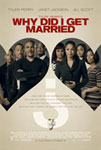
Why Did I
Get Married? is the fourth film that Perry has made in the
past three years, the third that he has adapted from one of his
plays. It has only been in release for a couple of weeks, and is
already a resounding success (especially when its measly
production budget is taken into account). Perry’s trademark
Madea isn’t present here, but the filmmaker headlines the cast
as usual, this time around playing Terry. Terry is one of the
members of four married couples who, every year, take a vacation
together to relax and focus on healing their apparently
always-troubled marriages. This year, the group of eight has
decided to rent a cozy cabin in the middle of a range of snowy,
isolated mountains – amidst a wealth of new marital problems.
Revelations and hardships ensue.
As was the case
with Perry’s two Madea-featuring films (Diary of a Mad Black
Woman and Madea’s Family Reuinion), Why Did I Get
Married? both endears by and suffers from so selectively
targeting an audience. Never in the course of this film’s
duration does Perry forget the demographic that makes up the
bulk of his ticket-buyers and, as a result, he haphazardly
throws in several story and character-related gimmicks to please
this demographic. On one hand, it’s great to see an oft-ignored
group of moviegoers finally being presented a work that they are
able to identify with. On the other hand, it’s unfortunate to
see films with as much promise as those of Perry bogged down by
unnecessary, erroneous material designed to appeal only to the
most viable audience. Whether this technique is implemented when
a character randomly reminisces about a part of Southern
Christian culture or forcedly embraces said culture’s vernacular
(I rolled my eyes every time the Los Angeles-based Janet Jackson
blurted out the terms “y’all” and “frontin’” in Why Did I Get
Married?), it always proves distracting and unnatural.
Then again,
Perry likely wouldn’t have found the success that he has had he
not formulated films that catered to such a specific audience.
His most mature work to date, Daddy’s Little Girls (not
adapted from one of his plays), was the most mainstream of his
efforts and was the only one of them to commercially tank. I am
almost content with the fact that I have never fully been able
to connect with Perry’s work due to its exclusivity, because in
said exclusivity he has forged a genuine excitement for
film and theatre in a group of people that rarely used to
patronize the Arts. Why Did I Get Married? surely suffers
artistically from several trivial quirks invented solely to
please its target demographic, but I’m not sure how significant
this is given the fact that only a minimal number of people who
don’t belong to said demographic will see the film. Perry’s
large fan-base will wholly appreciate the movie and, in the end,
this is all that really matters.
-Danny Baldwin,
Bucket Reviews
Review Published
on: 10.26.2007
Screened on:
10.13.2007 at the Edwards San Marcos 18 in San Marcos, CA.
Tyler Perry's Why Did I Get Married? is
rated PG-13 and runs 118 minutes.
Back to Home